
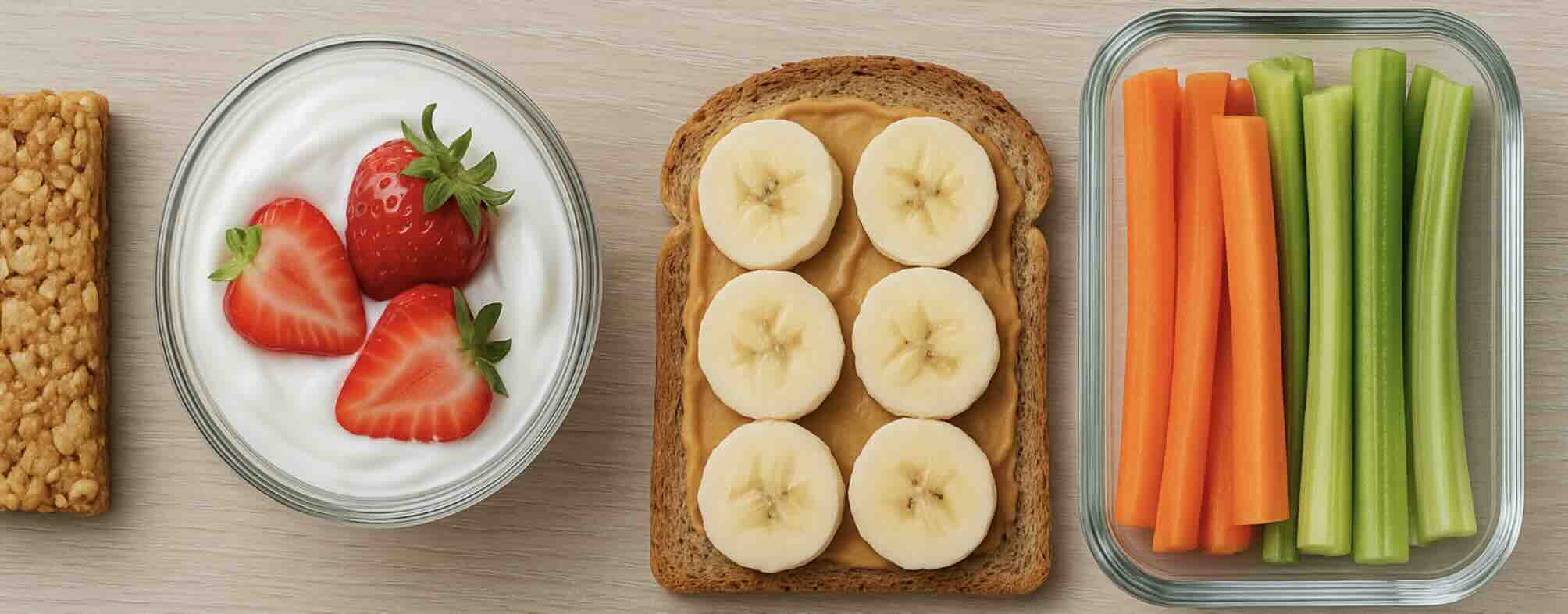
Quick answer: The best healthy snacks for work combine protein or healthy fat with a fiber-rich carbohydrate, are easy to store, and don't make a mess at your desk. Keep a drawer stocked with unsalted nuts, roasted chickpeas, whole-grain crackers, nut-butter packets, tuna pouches and fruit; use the office fridge for Greek yogurt, cheese sticks, hard-boiled eggs and hummus. Prep once a week and you'll spend less, eat less added sugar and salt, and avoid the vending machine.
This guide is built for real workdays: a shelf-stable desk-drawer shopping list, fridge options, quiet snacks you can eat in meetings, budget picks with approximate cost per serving, lower-salt and lower-sugar swaps, guidance for night shifts, and a simple weekly prep plan. If you mainly fight the mid-afternoon crash, pair this with our guide to snacks for the 3 PM energy slump.
Table of Contents
- What Makes a Good Work Snack
- Desk-Drawer Shopping List (Shelf-Stable)
- Office Fridge Options
- Quiet, No-Crunch Snacks for Meetings and Calls
- Snacks with Less Salt or Sugar
- Best-Value Snacks: Approximate Cost per Serving
- Snacks for Night Shifts and Overnight Work
- A Simple Weekly Prep Plan
- Frequently Asked Questions
What Makes a Good Work Snack
A snack that keeps you productive until the next meal usually ticks most of these boxes:
- Protein, fiber or both. These slow digestion and keep you full longer than chips or cookies. Our protein-rich snacks guide lists dozens of options.
- A sensible portion, usually about 150–250 calories for most adults.
- Low in added sugar and not too salty. More on label-reading below.
- Practical: no utensils (or one spoon), little smell, no sticky fingers on your keyboard.
- Pre-portioned. Eating from a large bag at your desk while you work makes it easy to lose track.
For a deeper look at which foods give steady fuel, see our main list of the best snacks for energy.
Desk-Drawer Shopping List (Shelf-Stable)
These keep for weeks or months unopened. Store them in a closed container to keep them fresh and away from pests.
| Item | Serving | Why it's useful (approx.) |
|---|---|---|
| Unsalted almonds, pistachios or mixed nuts | 1 oz (small handful) | ~160–170 cal, 5–6 g protein, healthy fats |
| Roasted chickpeas | 1 oz | Crunchy, ~5 g fiber, ~6 g protein |
| Dry-roasted edamame | 1 oz | ~11–13 g protein |
| Pumpkin or sunflower seeds | 1 oz | ~6–9 g protein, magnesium |
| Nut-butter squeeze packs | 1 pack (about 1–2 tbsp) | Turns fruit or crackers into a real snack |
| Tuna, salmon or chicken pouches | 2.5–3 oz pouch | ~15–20 g protein, no can opener |
| Whole-grain crackers or crispbread | Per label | Fiber-rich base for toppings |
| Plain instant oatmeal packets or oat cups | 1 packet | Warm, filling; add nuts for protein |
| Popcorn kernels or plain microwave popcorn | 3 cups popped | Under 100 cal air-popped, whole grain |
| Unsweetened dried fruit (apricots, raisins) | 2 tbsp–1/4 cup | Small portion; pair with nuts |
| Dark chocolate, 70%+ | 1–2 squares | Satisfies a sweet tooth in a small portion |
| Shelf-stable milk or soy milk cartons | 8 oz | Protein drink that doesn't need a fridge until opened |
| Whole fruit (bananas, apples, clementines) | 1 piece | Keeps several days at room temperature |
Want to make your own? Our roasted chickpeas recipe and no-bake energy balls are both cheaper than store-bought versions and easy to portion for the week.
Office Fridge Options
If you have access to a fridge, your options get much better. Label your containers and bring an insulated bag with an ice pack if the fridge is unreliable or crowded.
- Plain Greek yogurt (3/4 cup has roughly 15–17 g protein, approx.) with berries; or prep jars using our Greek yogurt parfait recipe.
- Cottage cheese with fruit or cucumber (about 12 g protein per 1/2 cup, approx.).
- Cheese sticks or cubes with grapes or an apple.
- Hard-boiled eggs (about 6 g protein each). Peel them at home to keep the smell down.
- Hummus with pre-cut vegetables such as carrots, peppers, snap peas and cucumber.
- Chia pudding jars made ahead with our chia pudding recipe.
- Overnight oats for a more filling mid-morning snack.
- Leftover grain bowls in small portions if lunch is early and you work late.
Food safety: perishable foods like yogurt, eggs and hummus shouldn't sit out at room temperature for more than about two hours (one hour if it's very hot). Keep the fridge at 40°F (4°C) or below and clear out old containers weekly.
Quiet, No-Crunch Snacks for Meetings and Calls
Crunchy snacks are great at your desk and terrible on an open mic. These are soft, quiet and low-mess:
- Banana: the original silent snack. Pair with a nut-butter pack.
- Greek yogurt or cottage cheese cup: one spoon, no noise.
- Energy balls: soft, bite-sized and easy to eat between sentences.
- Chia pudding or overnight oats: quiet and filling.
- Soft cheese with a ripe pear or peach slices.
- Dried apricots or dates with a few walnut halves. Walnuts are softer than almonds.
- Hummus on soft whole-wheat pita instead of crackers.
- A smoothie or a carton of milk or soy milk sipped through a straw.
Etiquette tip: skip strong-smelling foods (tuna, boiled eggs, reheated fish) in shared spaces and meeting rooms, and avoid peeling a clementine right before a call; the scent travels. If a colleague has a severe nut allergy, check your workplace's policy before bringing nut snacks into shared areas.
Snacks with Less Salt or Sugar
Many convenient work snacks (crackers, pretzels, jerky, instant soups, flavored nuts, granola and protein bars) carry a lot of sodium or added sugar. A few simple rules make it easier:
- Use the % Daily Value. According to FDA guidance, 5% DV or less of sodium or added sugars per serving is considered low, and 20% DV or more is high. The Daily Value is 2,300 mg for sodium and 50 g for added sugars.
- Look for "unsalted" or "no salt added" on nuts, seeds and canned beans or fish. You can mix half salted and half unsalted nuts if plain ones taste too bland.
- Choose plain, then add your own flavor: plain yogurt with fruit, plain oatmeal with cinnamon, unsweetened dried fruit.
- Treat jerky as an occasional pick. It's high in protein, but many brands have several hundred milligrams of sodium per ounce.
- Check bars carefully. The American Heart Association suggests limiting added sugar to about 25 g a day for most women and 36 g for most men, and one bar can use up a big share of that.
| Instead of... | Try... |
|---|---|
| Pretzels or salted crackers | Air-popped popcorn or unsalted roasted chickpeas |
| Honey-roasted or flavored nuts | Unsalted almonds with a few dark chocolate chips |
| Fruit-flavored yogurt | Plain Greek yogurt with fresh or frozen berries |
| Granola bar with lots of added sugar | Homemade energy balls or a banana with nut butter |
| Instant noodle cup | Plain oatmeal cup with nuts, or a tuna pouch with crackers |
| Soda or sweet tea | Sparkling water with citrus, or unsweetened tea |
Our low-sugar snacks guide has more swaps if you're cutting back on sugar.
Best-Value Snacks: Approximate Cost per Serving
Workplace snacking adds up quickly if you buy from a vending machine or coffee shop every day. The figures below are rounded, approximate US grocery prices for store-brand or bulk purchases; actual costs vary a lot by region, store and season, so treat them as a rough comparison only.
| Snack | Serving | Approx. cost per serving |
|---|---|---|
| Air-popped popcorn (from kernels) | 3 cups popped | $0.10–$0.20 |
| Plain oatmeal (canister oats) | 1/2 cup dry | $0.15–$0.25 |
| Banana | 1 medium | $0.25–$0.35 |
| Peanut butter | 2 tbsp | $0.20–$0.30 |
| Sunflower seeds | 1 oz | $0.20–$0.35 |
| Hard-boiled egg | 1 large | $0.25–$0.50 |
| Homemade roasted chickpeas | About 1/3 can | $0.30–$0.50 |
| Baby carrots with homemade hummus | 1 cup carrots + 1/4 cup hummus | $0.50–$0.80 |
| Almonds (bulk) | 1 oz | $0.40–$0.70 |
| Plain Greek yogurt (large tub) | 3/4 cup | $0.75–$1.00 |
| Canned or pouched tuna | 1 can or pouch | $1.00–$1.50 |
| For comparison: protein bar or beef jerky | 1 bar / 1 oz | $1.50–$2.50 |
Best value for energy: a banana with peanut butter, oatmeal with a spoon of nut butter, or popcorn with a handful of sunflower seeds all cost well under a dollar and combine carbohydrate with protein or fat. Buying a large tub of yogurt instead of single cups and bulk nuts instead of snack packs are the easiest savings.
Snacks for Night Shifts and Overnight Work
Working through the night means eating when your body clock expects you to be asleep. Research on shift workers suggests the body tends to handle large meals less well during the biological night, and heavy food can leave you sluggish or with an upset stomach. A few general principles help:
- Eat a proper meal before your shift, for example in the early evening, so you're not running on empty.
- Keep overnight eating light. Instead of a big meal at 2 or 3 AM, have one or two smaller snacks with protein and fiber, such as yogurt with fruit, a hummus wrap, eggs, or nuts and an apple.
- Front-load caffeine. Have coffee or tea early in the shift and stop several hours before you plan to sleep, so it doesn't cut into your daytime rest.
- Hydrate steadily with water throughout the shift.
- Avoid sugary "pick-me-ups" in the small hours, when your energy is already at its lowest.
- Before sleeping after a shift, a small, light snack (such as a banana or a small bowl of oatmeal) is easier to sleep on than a large, greasy breakfast. See our sleep-promoting snacks guide for ideas.
| Point in a 7 PM–7 AM shift | Suggested eating |
|---|---|
| 5–6 PM (before shift) | Balanced main meal: protein, vegetables, whole grains |
| 9–10 PM | Coffee or tea if you use caffeine, plus fruit and nuts |
| 12–1 AM | Light "meal" snack: wrap, yogurt bowl, eggs and crackers |
| 3–4 AM | Small snack only if hungry: cheese and an apple, chia pudding; water |
| After shift, before sleep | Small, light snack if hungry; no caffeine |
Safety Note
If you have diabetes or another condition that affects blood sugar, or you're pregnant, shift work can complicate meal timing; ask your doctor or a registered dietitian for a plan that fits your schedule and medication. Always check labels for allergens such as nuts, peanuts, dairy, soy, sesame and gluten. See our health disclaimer.
A Simple Weekly Prep Plan
Thirty to sixty minutes on the weekend covers most of your workweek snacks.
Weekend Prep (about 45 minutes)
- Boil 6–8 eggs; cool, peel and refrigerate (eat within about a week).
- Roast one or two cans of chickpeas and portion into small containers.
- Roll a batch of energy balls and refrigerate.
- Make 3 jars of chia pudding or overnight oats.
- Wash and cut vegetables (carrots, peppers, cucumber, snap peas) and portion with hummus.
- Portion nuts and seeds into 1-oz containers or bags.
- Restock the desk drawer: crackers, pouches, nut-butter packs, oatmeal.
Sample Week
| Day | Mid-morning | Mid-afternoon |
|---|---|---|
| Monday | Greek yogurt parfait | Apple + nut-butter pack |
| Tuesday | Hard-boiled egg + whole-grain crackers | Roasted chickpeas + clementine |
| Wednesday | Chia pudding | Veggies + hummus (refresh produce today) |
| Thursday | Banana + 1 oz almonds | 2 energy balls + green tea |
| Friday | Cottage cheese + fruit | Popcorn + cheese stick |
Not everyone needs two snacks a day. If you eat a solid breakfast and lunch and aren't hungry, skip one; snacks are there to bridge long gaps, not to fill every break.
Frequently Asked Questions
What are the best energy snacks for work?
Snacks that combine protein or healthy fat with a fiber-rich carbohydrate work best: a banana or apple with nut butter, Greek yogurt with berries, nuts with fruit, a hard-boiled egg with whole-grain crackers, hummus with vegetables, or homemade energy balls.
What healthy snacks can I keep at my desk without a fridge?
Unsalted nuts and seeds, roasted chickpeas, dry-roasted edamame, nut-butter packets, tuna or salmon pouches, whole-grain crackers, plain oatmeal packets, popcorn, unsweetened dried fruit, shelf-stable milk cartons and whole fruit such as bananas, apples and clementines.
What are quiet snacks to eat at your desk or in meetings?
Bananas, yogurt or cottage cheese cups, energy balls, chia pudding, overnight oats, soft cheese with ripe fruit, dried apricots or dates with walnuts, hummus on soft pita, and smoothies are all quiet and low-mess. Avoid strong-smelling foods in shared rooms.
What are healthy work snacks with less salt or sugar?
Choose unsalted nuts and seeds, plain Greek yogurt with fruit, plain oatmeal with cinnamon, air-popped popcorn, fresh fruit and vegetables with hummus. On labels, 5% Daily Value or less of sodium or added sugars per serving is considered low and 20% or more is high.
What are the best-value healthy snacks for every day?
Popcorn made from kernels, plain oats, bananas, peanut butter, sunflower seeds, eggs and homemade roasted chickpeas are among the cheapest, often well under a dollar per serving at approximate US grocery prices. Buying large tubs and bulk bags instead of single-serve packs saves the most.
What should I eat during a night shift?
Eat a balanced meal before your shift, then keep overnight eating light with one or two smaller snacks that include protein and fiber, such as yogurt with fruit, eggs with crackers or a small wrap. Have caffeine early in the shift, drink water steadily and avoid heavy meals in the early morning hours.
How many snacks should I eat at work?
It depends on your meals and schedule. Many people do well with one or two snacks of about 150–250 calories to bridge long gaps between meals. If you aren't hungry, there's no need to snack just because it's break time.
How long can work snacks stay out of the fridge?
Perishable foods such as yogurt, cheese, eggs and hummus shouldn't sit at room temperature for more than about two hours, or one hour in very hot conditions. Use an insulated bag with an ice pack if you don't have a reliable fridge.
About This Guide
Written and maintained by the HealthSnackIdeas Editorial Team. We build our snack guides from publicly available nutrition research and dietary guidelines (USDA FoodData Central, Dietary Guidelines for Americans, WHO). This content is for general information only and is not a substitute for advice from your doctor or a registered dietitian. Read our health disclaimer.